Party Playlists and Cheap Sound: Making a $60 Speaker Fill a Backyard
Placement physics, the two-zone rule, and the three-hour playlist arc — how one $60 Bluetooth speaker does the job people rent $400 PA systems for.
Prices researched in October 2026 from US retailers and national averages. Nothing here is sponsored. Full disclaimer
On this page4 sections
At some point during every backyard party I host, somebody asks where the speakers are hidden. Plural. There is one speaker. It cost about as much as two pizzas, and it's usually sitting on a stepladder behind a plant. The question comes because the music is everywhere and not loud — which people's ears read as an installed system — and getting that effect out of a $60 box is not an audio-engineering achievement. It's four placement decisions and a playlist built like a dinner menu instead of a jukebox.
I learned this backwards, by spending money in the wrong order: a bigger speaker, then a second bigger speaker, then almost — almost — a rented PA with a subwoofer for the quinceañera, before the DJ we hired anyway taught me the placement rules while setting up his own rig. He ran a professional system, but the physics he was exploiting are free, and they work on a $60 Bluetooth speaker the same way they work on his $4,000 of gear. Here's all of it.
Buy the boring speaker
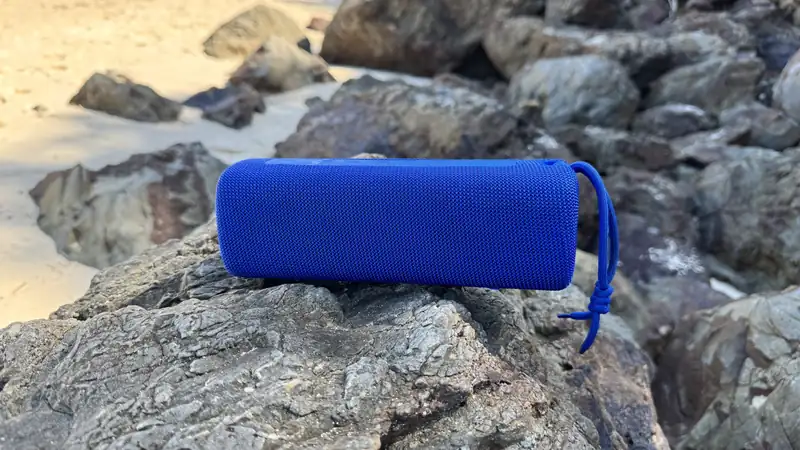
The $50–70 class of Bluetooth speaker is the best value tier in consumer audio right now — the point where waterproofing, 12+ hour batteries, and real mid-bass all show up, and roughly where diminishing returns begin for party purposes. Anker's Soundcore line camps in this zone (their boom-style units float around $50–70 on regular deals), Tribit's StormBox family likewise; any of them beats the $25 tier decisively, and the $150 tier beats them by less than the spec sheet implies. What actually matters on the box:
- 12+ hours of battery, because a party speaker on a charger cable is a speaker that ends up next to an outlet instead of where it belongs.
- IPX5 or better, because backyard speakers live near coolers, sprinklers, and enthusiasm.
- A second one later beats a bigger one now. Two cheap speakers running as a stereo/party pair — a standard feature within a brand — is the correct upgrade path, and it's the placement upgrade, not the volume upgrade. More on why below.
Placement is the whole product
The same speaker, moved ten feet, is a different speaker. The four rules, in order of how much they matter:
1. Height. Get it to ear level or above. A speaker on the ground fires its sound into the first three rows of human legs, which absorb it — every body between source and listener eats treble. On a table it's better; on a stepladder, deck rail, or fence post at 5–6 feet, the sound travels over heads and suddenly "fills" the yard. This one free move is half the mystery of professional-sounding backyards; it's why every DJ rig you've ever seen is on poles.
2. Corners and walls are free amplifiers. A speaker placed near the house wall, or better, tucked toward a corner where wall meets patio, reflects energy back into the yard instead of donating it to the neighborhood behind it. Boundary loading adds real, audible low-end — free bass, aimed at your party.
3. Aim it across the space, not at it. Point the speaker diagonally across the longest dimension of the yard. Sound falls off fast with distance from a small box; the diagonal buys the longest even-coverage line, so the people near it aren't blasted while the far corner strains.
4. The two-zone rule. Never try to cover the whole party evenly — you don't want to. A party needs a music zone (patio, dance-adjacent, food table) and a conversation zone where the volume drops off enough to talk quietly, and a single well-placed speaker creates both automatically if you stop fighting the falloff. This is a hearing-and-humanity issue as much as taste: sustained sound over 85 dB is where NIOSH draws the hearing-risk line, and a conversation at normal voice needs the background closer to 60. The far end of the yard being quieter isn't your speaker failing. It's your floor plan working.
The playlist is a three-hour arc, not a genre
The other half of "how is one speaker doing this" is that a well-built playlist sounds bigger, because dynamics create the impression of a system responding to the room. Build it like a menu — courses, not a pile:
| Hour | Energy | What's playing | Volume move |
|---|---|---|---|
| Arrival (0–1) | Warm, familiar, mid-tempo | Songs people know but wouldn't request | Low — under conversation |
| Middle (1–2) | Rising, rhythmic | The crowd-pleasers, the nostalgia run | Up one notch at the hour mark |
| Peak (2–2:45) | Full | The songs people sing along to badly | Up one more, briefly |
| Landing (last 30) | Falling, warm again | Slower, familiar, "one more drink" music | Back down — this empties the yard gently |
Source: Party Wealth price research.
Three craft rules from years of tinkering: front-load familiarity (arrival-hour deep cuts make guests feel like visitors in your taste; save discoveries for the middle, sandwiched between songs everyone knows); the volume notch at hour one is the party's gear shift — guests read the room getting louder as the party succeeding, and a deliberate +1 beats the host reactively cranking it at 9 p.m.; and build 5+ hours of playlist for a 3-hour party, shuffled off, so the arc plays in order and nobody hears the playlist "loop," which is the tell of an under-planned night. The landing sequence matters more than the peak — the same guest-psychology as the two-hour weeknight party's hard ending: people leave when the environment suggests it, and descending music is the politest suggestion ever invented.
For the record, the entire rig, receipted:
- Bluetooth speaker, $50–70 class (on sale)$54.00
- Stepladder (already owned; the fence post is free)$0.00
- 3M outdoor hook for the fence-post option$4.00
- Aux cable, backup for Bluetooth's bad nights$6.00
- Playlist: two evenings of pleasant obsession$0.00
- Total$64.00
The $400 rented PA covers the same square footage louder, which is a different goal. This rig covers it evenly, which is the goal parties actually have.
What the $60 doesn't cover (and what to do about it)
Marisol Vega
Marisol is a serial host from Texas who has thrown everything from an 8-person dinner party to a 120-guest backyard quinceañera, and budgets every event in a spreadsheet before she buys a single bag of ice. She publishes the spreadsheets here so your money lands where guests will actually notice it.
No certifications, no celebrity clients, no event-planning firm — the authority here is itemized receipts, per-guest quantities, and timelines that survived contact with real parties.