"The 2-Hour Party Reset: Hosting on a Weeknight Without Takeout Prices"
A minute-by-minute plan for hosting dinner for six on a weeknight, between 5:30 and 7:30 — pantry menus, real costs, and the reset that makes it repeatable.
Prices researched in August 2026 from US retailers and national averages. Nothing here is sponsored. Full disclaimer
On this page6 sections
The parties that changed my social life weren't the big ones. They were Tuesdays. At some point I noticed that my friends and I had quietly agreed that seeing each other required three weeks' notice and a Saturday, and that the alternative — "come over tonight" — felt impossible because hosting had inflated into an event. So I built a system for the other kind of hosting: guests at 7:30, home from work at 5:30, dinner for six, no takeout, no $180 panic-cater. Two hours, start to seated.
I've run this reset dozens of times now. Here's the clock, the menu math, and the checklist that makes "come over tonight" a thing you can actually say.
First, the math that makes it worth it
| Feeding 6 on a Tuesday | Cost | Arrives |
|---|---|---|
| Delivery pizza + drinks | $55–75 | In a soggy box |
| App-delivered restaurant food | $95–130 | 50 min, lukewarm |
| The 2-Hour Reset dinner | $41–48 | From your oven, hot |
Source: Party Wealth price research.
The pantry doctrine: shop never, cook always
The reset only works if there's no shopping trip inside the two hours. That means a standing pantry roster, restocked on normal grocery runs, from which at least two full company-worthy dinners can always be assembled:
- The backbone: 2 lb of dried pasta, arborio rice, a jar of good tomatoes or passata, olive oil, parmesan (the real wedge — it keeps for months), canned white beans, anchovies or capers, garlic, onions, chicken stock.
- The freezer bench: a bag of Italian sausage or meatballs, a loaf of decent bread (freezes perfectly, revives at 375°F in ten minutes), a bag of peas or spinach, butter.
- The gloss: one lemon, red pepper flakes, a bar of chocolate, a bag of coffee. The gloss items are what make a pantry meal read as intentional.
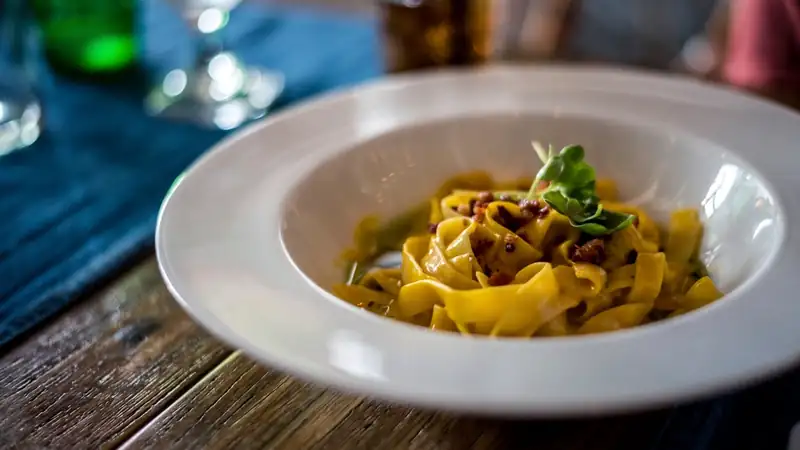
Total standing investment: maybe $45, of which you use $15–20 per dinner and replace as you go. The menu this builds: a big sausage ragù or cacio-e-pepe-adjacent pasta, warm bread with butter, a fast salad if there's anything green in the crisper (and honest absence if there isn't), and chocolate broken onto a plate with coffee for dessert. Broken-bar chocolate on a nice plate is a dessert course; a supermarket cake sweated in its plastic dome is an apology. Same $6.
The clock: 5:30 to 7:30
This is the actual minute-by-minute I follow. The order matters more than the speed — notice that nothing about food happens in the first half hour.
5:30–6:00 — The space, not the food. Guests experience the room before they taste anything, so the room goes first: dishwasher emptied (an empty dishwasher is weeknight hosting's secret weapon — mess disappears during the party), counters cleared with a laundry-basket sweep of clutter into the bedroom (zero shame, full effectiveness), table set, overheads off, lamps on, two candles lit, playlist on. Twenty-five minutes, and the house is 80% "ready" while the kitchen is still cold.
6:00–6:15 — The bathroom and the bar. Bathroom gets the two-minute treatment: counter wipe, fresh hand towel, spare roll visible, candle. It's the highest-leverage room in the house — it made the top five of what guests actually notice across 50+ parties, and on a weeknight it's the room that most loudly signals "we meant for you to be here." The bar is a pitcher of iced tea or a batched drink if it's that kind of Tuesday; the signature-cocktail logic applies at weeknight scale — one option, batched, done.
6:15–7:10 — The actual cooking. Ragù simmering by 6:35 (sausage browned, tomatoes in, lowest flame — it improves untouched from here). Pasta water on at 6:50 but not boiling pasta yet. Bread from freezer to oven at 7:00. Salad assembled, undressed, in the fridge. The dish you choose must pass the reset test: under 20 minutes of attention, holds happily for 30 if people run late. Braises, ragùs, sheet-pan things, soups — yes. Risotto, fried anything, individual plating — that's Saturday food.
7:30 — Door. Drinks poured within four minutes of arrival (the only hard rule of arrival), pasta dropped when the second guest walks in, dinner on the table by 7:55. Portions come straight off the per-guest cheat sheet: 4 oz dry pasta per person as a main means 24 oz — 1.5 boxes — feeds six with seconds for the two people who'll want them.
The rotation: three menus so it never gets old
The reset dies if it calcifies into The Pasta Again, so mine runs on a three-menu rotation, all pantry-compatible, all under $50 for six:
- Menu A, the ragù night (described above): sausage ragù, pasta, frozen-revived bread, chocolate and coffee. About $42. The default, because it makes the house smell like you tried for hours.
- Menu B, the beans-and-greens night: white beans braised with garlic, rosemary, and parmesan rinds (the rinds you've been saving — the pantry doctrine's best free ingredient), over toast, with fried eggs on top for whoever wants one. Eggs at roughly $2.19 a dozen in mid-2026 make this the cheapest menu in the rotation, around $28 for six, and it's somehow the one guests request. There's no protein flex, and nobody misses it.
- Menu C, the soup night: a big pot of whatever-soup (potato-leek, white chicken chili from freezer-bench thighs, tortilla soup), a bag of tortilla chips deployed as both garnish and appetizer, quesadillas cut into sixths for the table. About $36. Best for cold months and crowds with kids.
The rotation also solves the reciprocity stall — the thing where nobody hosts because everybody's waiting for a fancier kitchen or a bigger table. When your friends learn that Tuesday dinner at your place is beans on toast with a fried egg and a lit candle, two things happen: they relax, and then they start doing it too. Three of my regular guests now run their own weeknight menus, and my calendar has more dinners on it than any Saturday-only era ever produced.
The reset after the reset
What this is really for
Run the numbers across a year and the reset looks like a personal finance article: hosting friends twice a month this way instead of "grabbing dinner somewhere" saves a couples' restaurant tab of $80–120 each time — call it $1,500–2,500 a year — while feeding more people, better. But the honest reason I do it isn't the spreadsheet, and I say that as the person with the spreadsheets. It's that friendship on three weeks' notice isn't really how friendship works. The people in your life need to see your house with mail on the counter, eat pasta off your everyday plates, and leave by 9:40 because it's a school night. Two hours, forty-five dollars, no occasion. That's the whole recipe, and it's the best per-dollar value in this entire site's archive of budgets.
Marisol Vega
Marisol is a serial host from Texas who has thrown everything from an 8-person dinner party to a 120-guest backyard quinceañera, and budgets every event in a spreadsheet before she buys a single bag of ice. She publishes the spreadsheets here so your money lands where guests will actually notice it.
No certifications, no celebrity clients, no event-planning firm — the authority here is itemized receipts, per-guest quantities, and timelines that survived contact with real parties.