"The Leftover Plan: Carving, Packing and Sending Thanksgiving Home on the USDA Clock"
The two-hour clock starts when the turkey leaves the oven, not when dinner ends. Here's the carve-first routine, the 40-cent take-home kit, and the freezer trick.
Prices researched in November 2026 from US retailers and national averages. Nothing here is sponsored. Full disclaimer
On this page9 sections
Every Thanksgiving I've hosted has ended the same way: a kitchen full of people who love me, all offering to help, and a turkey carcass that has been sitting on the counter since before the pie came out. Everybody is full and happy. Nobody is watching the clock. And the clock, it turns out, started a lot earlier than anyone at my table thought.
This is the plan I now run from the moment the bird leaves the oven to the Monday after, organized not by the hour but by where the food ends up: the carving board, the fridge, the take-home bags, the freezer, and the microwave. Every rule in it comes from the USDA's food-safety people, and every price was checked in September 2026.
The clock starts at the oven door
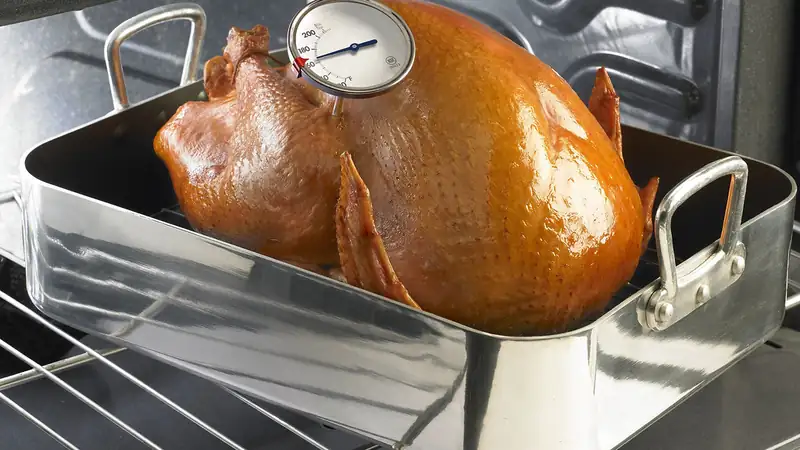
Here is the sentence that changed how I run the end of the meal. FoodSafety.gov's guidance is that perishable food should be refrigerated within two hours of coming out of the oven or refrigerator. Not two hours after the last person puts down a fork. Two hours from the oven door.
That matters because Thanksgiving food leaves the heat at very different times. In my one-oven slot plan, the turkey comes out at 3:05 to rest, the sides follow at 3:45, and dinner is on the table right after. Which means the turkey is the first dish to time out, at 5:05, not the last. By the time somebody cuts the pumpkin pie at 5:30, the bird has been out for two hours and twenty-five minutes, and a large animal is still sitting whole on a platter.
So the single most useful habit in this article is dull: carve and stash the turkey before dessert. Not the sides, which have more slack. The turkey.
Stop one: the carving board
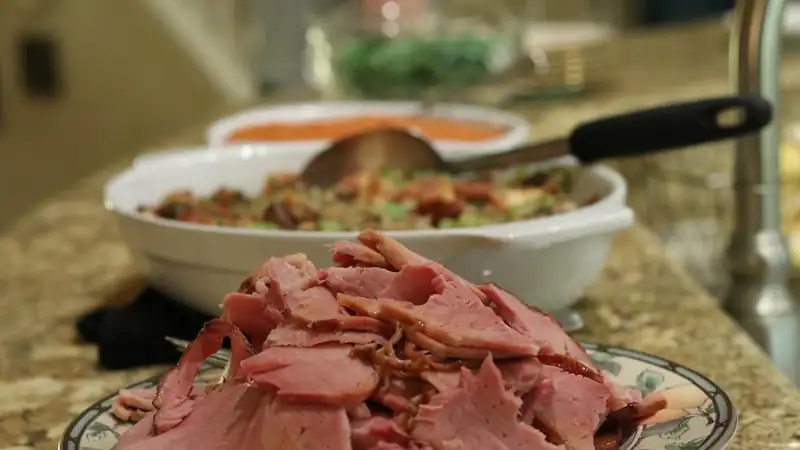
The FSIS instruction is specific, and it's worth following exactly: cut the turkey into smaller pieces and refrigerate; slice breast meat; legs and wings may be left whole. The same page says to take all stuffing out of the cavity immediately and refrigerate it on its own. A whole bird in the fridge is a big dense block that cools from the outside in; a pile of sliced breast in a shallow container is not.
My routine, which goes quickly with one helper:
- Pull both legs and wings off whole. They go into one container as-is.
- Slice both breast halves off the frame, then slice them across the grain. That's the good container.
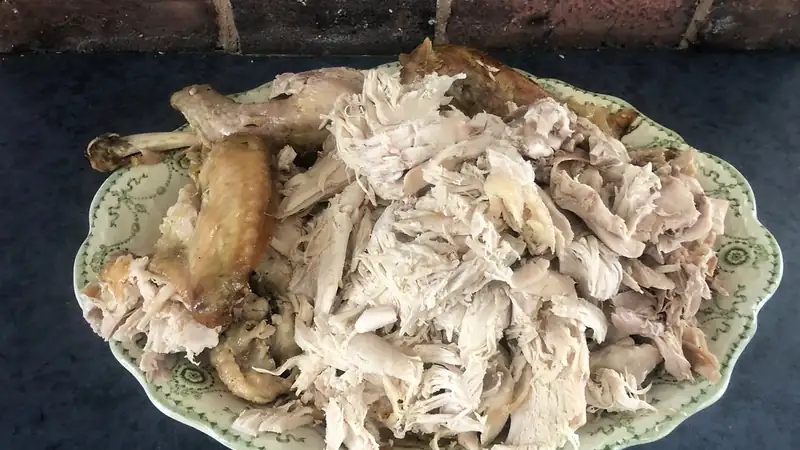
- Pick the carcass for the odd bits — the oysters, the back meat — into a third container marked "soup."
- The carcass itself goes into a gallon bag or straight into a stockpot. If I'm not making stock within a day or two, it goes in the freezer.
Stop two: the fridge, while it's still steaming
The problem on Thanksgiving is not the rule. It's fridge space. Your fridge is already carrying the drinks, the whipped cream and whatever a guest brought that "needs to stay cold." Clear a shelf before dinner — move the drinks to a cooler on the porch, where November is doing the work for free — and you have somewhere to put eight shallow containers at 5:00 without a game of Tetris.
How long everything lasts
The one number everybody half-remembers is "three to four days," and it is right for most of the table. The FoodSafety.gov team turns it into a date: use the Monday after Thanksgiving as the last day to eat refrigerated leftovers. With Thanksgiving on November 26 in 2026, that's Monday, November 30, 2026. After that, it's freezer or trash.
| Leftover | Fridge, 40°F or below | Freezer, 0°F | Source |
|---|---|---|---|
| Turkey, plain slices or pieces | 3 to 4 days | 4 months | FSIS |
| Turkey covered in broth or gravy | 3 to 4 days | 6 months | FSIS |
| Stuffing, gravy, cooked poultry dishes | 3 to 4 days | 4 to 6 months | FSIS |
| Casseroles made with eggs | 3 to 4 days | 2 to 3 months | FoodSafety.gov |
| Pumpkin or pecan pie | 3 to 4 days | 1 to 2 months | FoodSafety.gov |
| Soup made from the carcass | 3 to 4 days | 2 to 3 months | FoodSafety.gov |
Sources: USDA FSIS cooked-dinner guidance and the FoodSafety.gov cold storage chart, checked September 2026.
The freezer trick hiding in that table
Look at the first two rows again. Plain turkey is rated for four months of freezer quality. The same turkey covered in broth or gravy is rated for six. That's in the FSIS cooked-dinner guidance, and it is the most useful line in this whole article that nobody talks about.
The reason is freezer burn. Air is what dries frozen meat out, and a layer of liquid keeps the air off. So I freeze turkey the way that table quietly recommends: sliced breast in a flat container, leftover gravy (or a cup of that carcass stock) poured over until it's covered, lid on, labeled. In February, that container reheats into something that tastes like November instead of like the back of the freezer.
Stop three: the take-home bags
I stopped sending leftovers home on my good plates in 2019, after the third plate didn't come back. Now I buy a pack of deli containers every fall. A 50-pack of 16-ounce containers with lids was $19.97 at Walmart when I checked in September 2026, which is 40 cents each. They stack, they go in the microwave, they go in the freezer, and nobody has to bring them back.
The plan for ten guests is four containers per household: one turkey, one starch, one vegetable, one pie. Five households is twenty containers, $7.99 of plastic. Here's the full kit.
- 16-oz deli containers with lids, 50-pack$19.97
- Used tonight: 20 containers at about 40¢$7.99
- Painter's tape and a marker for labelsalready in the drawer
- Paper grocery bags, one per householdsaved from shopping trips
- Tonight's cost$7.99
Container price checked at Walmart in September 2026; the other 30 containers carry into the Christmas cookie tins, the soup, and next year. The tape and bags are what I already had. If you don't have them, a roll of painter's tape runs a few dollars wherever you shop.
The tape is the part I'd defend. Every container gets a strip on the lid that says what it is and "eat by Mon 11/30." Guests don't know when your turkey came out of the oven. They'll take the date on the lid seriously if you write one; they will not look it up.
Pack the bags in the last half-hour, while the pie is being eaten — the counter is clear because the turkey went away at 5:00, and your helper already knows where the containers are. And put the bags in the fridge until people leave, not on the counter by the door. The two-hour clock doesn't pause because the food has been packed. FSIS's version is to refrigerate cold food as soon as you get home, always within two hours; if someone has a long drive, give them a bag of ice to set on top, or send them with a cooler.
Stop four: the reheat
Most leftover advice ends at the fridge door, and most leftover disappointment happens at the microwave.
- Everything gets to 165°F. Federal guidance is to reheat leftovers to 165°F, as measured with a food thermometer. Cover the dish, and stir or rotate halfway so there isn't a cold center.
- Gravy and soup come to a rolling boil, not just "hot."
- Don't reheat a whole turkey. FSIS says flatly that it isn't recommended. Cut it into small pieces first.
- Thaw frozen leftovers in the fridge on a tray, or reheat straight from frozen in a covered pot. The only way I've ever ruined good frozen turkey is by thawing it on the counter "just for an hour."
The best leftover meal in my house is the Friday brunch, when turkey hash and a pan of reheated stuffing do the work of a whole grocery run. It's the same move I use for feeding overnight guests the morning after a party: cook once for the crowd, then let tomorrow's meal come out of today's fridge.
How much to plan for leftovers in the first place
If you want leftovers to send home, you have to cook for them on purpose. FSIS's rule of thumb is a pound of whole turkey per person, which is a served portion and not much more; I buy closer to a pound and a half a head for exactly this reason, and the math for everything else is on my per-guest quantity cheat sheet. The trick is to buy the leftover share of the bird on purpose, rather than hoping for it.
And if you're the one who ends up with a question at 11 a.m. on the day itself, the USDA Meat and Poultry Hotline is open on Thanksgiving Day from 8 a.m. to 2 p.m. Eastern at 1-888-674-6854. It's staffed by real food-safety specialists. I've never had to call it — but I keep the number on the fridge next to the timeline, because the day you need it is the day you won't want to look it up.
The whole plan on one card
- Before dinner: clear a fridge shelf. Drinks go to a cooler outside.
- Turkey out (3:05 in my plan): your two-hour clock starts now.
- Before pie: carve. Breast sliced, legs whole, stuffing out of the cavity, all into shallow containers and into the fridge while it's still warm.
- During pie: pack the take-home containers, tape the labels, fridge the bags.
- Sides: in the fridge within two hours of leaving the oven.
- Friday: freeze anything you won't eat by Monday, turkey under gravy.
- Monday, November 30: last day for the fridge.
The first year I ran it, nothing about the evening felt different, except that I sat down for pie. That's the whole reward. The food safety is real, and the quiet version of it is that the host gets to eat dessert.
Marisol Vega
Marisol is a serial host from Texas who has thrown everything from an 8-person dinner party to a 120-guest backyard quinceañera, and budgets every event in a spreadsheet before she buys a single bag of ice. She publishes the spreadsheets here so your money lands where guests will actually notice it.
No certifications, no celebrity clients, no event-planning firm — the authority here is itemized receipts, per-guest quantities, and timelines that survived contact with real parties.